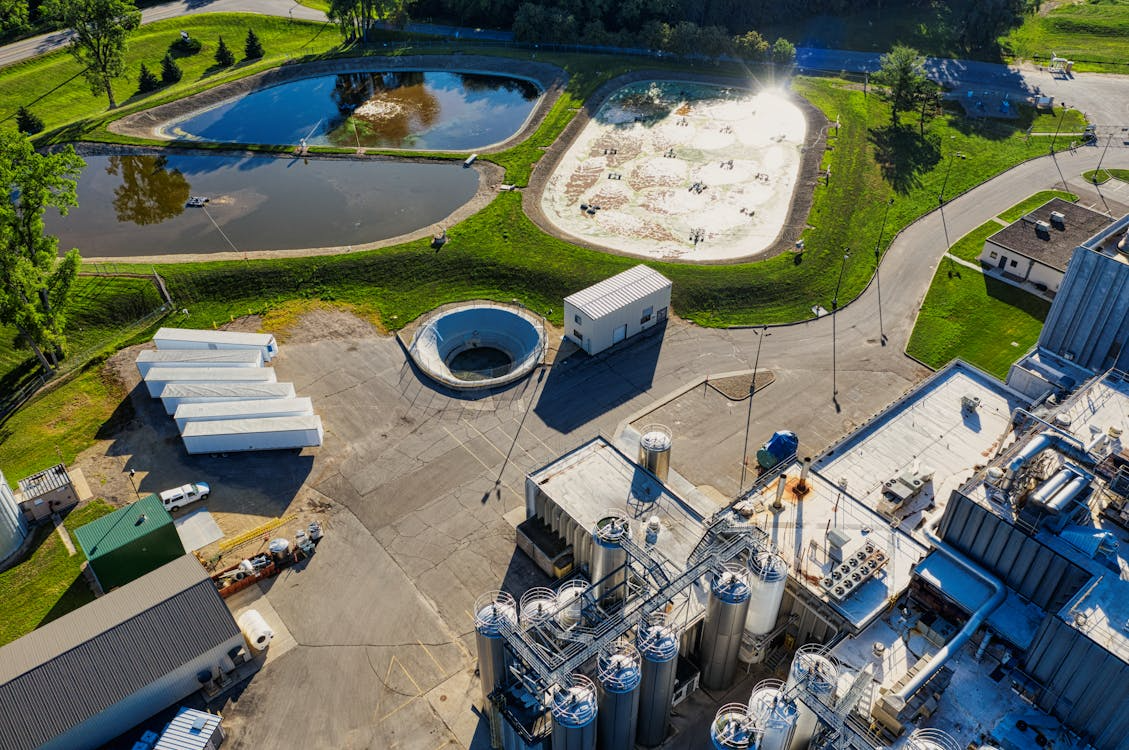
So, how exactly does a modern wastewater treatment plant ‘digest’ the wastewater?
Typically, municipal wastewater treatment goes through several key stages. The first is pretreatment, where coarse screens intercept large debris like plastic bags and branches, followed by grit chambers to remove inorganic particles like sand and gravel, preventing wear and tear or blockages in subsequent equipment. Next comes biological treatment, which uses microorganisms to break down organic pollutants in the wastewater; this is the core stage determining effluent quality. Afterwards, sedimentation separation is used to settle suspended solids and microbial flocs in the water, ultimately achieving compliant discharge or reuse.
At this point, many might think ‘wastewater treatment is complete’. But from an engineering perspective, the factors that truly affect operational costs often only begin at this stage – sludge treatment.
This is because the pollutants in the wastewater have not disappeared; they have simply been concentrated into another form: sludge. This sludge typically has a moisture content as high as 97%-99%, is bulky and highly fluid. Without further treatment, it is difficult to transport and cannot be disposed of economically. Therefore, modern wastewater treatment plants are generally equipped with sludge treatment systems, commonly following this route: thickening > dewatering > transportation > final disposal or resource recovery.
Among these, ‘thickening’ and ‘dewatering’ are the core steps that transform sludge from a ‘liquid burden’ into a ‘manageable solid material’. Thickening serves to first separate as much free water as possible, reducing the load on subsequent dewatering. Dewatering then further reduces the moisture content, forming a sludge cake that is easier to stack, load, and transport, thereby significantly lowering transportation and disposal costs.
In practical applications, the combined process of belt thickening and belt pressing is adopted by many municipal projects due to its continuous operation, strong adaptability, and relatively convenient maintenance. After pre-thickening, the sludge enters the pressing stage, where moisture is released through stepwise pressurisation, ultimately forming sludge cake. For municipal sludge, the value of equipment often lies not only in ‘achieving drier solids’ but also in its ability to maintain stability over long-term operation – for example, whether the feed is uniform, whether the filter belt operates reliably, whether the tension pressure is adjustable, whether side leakage risks are controllable, and whether the control system is easy to operate and manage.
Precisely because of this, the ‘present life’ of modern municipal wastewater treatment increasingly emphasises system synergy: the wastewater treatment process determines sludge characteristics, sludge characteristics affect dewatering efficiency and disposal methods, and dewatering performance is directly linked to operational costs and urban management pressures. Today’s wastewater treatment plant is no longer just a ‘place that treats dirty water’ but rather an integrated engineering system encompassing water, sludge, energy consumption, operational stability, and sustainable development.
When we visit a modern wastewater treatment plant, we see not only clean water being discharged but also an entire low-profile yet sophisticated urban safeguard system in continuous operation. And within it, the often-overlooked stage of sludge thickening and dewatering is quietly determining whether the city can handle its own ‘by-products’ more efficiently and sustainably.
Post time: Jan-23-2026